A language does not die all at once. It recedes first from daily use, then from memory, then from the imagination. By the time it is declared lost, an entire way of sensing the world, imagining the world has already gone with it. Every two weeks, a language dies!
I learned language before I learned literature.
I do not mean language as grammar or vocabulary, but language as a way of entering the world. For those of us formed by migration, language arrived in layers. It came through prayer and instruction, through the social music of elders, through the smell of food prepared for guests, through gesture, tact, emphasis, and restraint. It came through story, certainly, but also through pause, through what was withheld, through what had to be inferred from tone, from glance, from the emotional weather of a room after news arrived from somewhere else.
For the Ismaili community, whose routes moved from India to East Africa and then on to Europe and North America, meaning was never secured in one place. It travelled. It was carried in devotional forms, family habits, oral histories, photographs without captions, names altered by empire and border, and in the body’s own archive of touch, smell, and repetition. Writing entered my life through that world, not apart from it. So did reading. To read was never only to decode text. It was to recognize a pattern of life.
That mattered because migration rearranges perception. What one leaves behind does not disappear. It changes state. The house becomes atmosphere. The street becomes cadence. A room survives as light falling at a certain angle. A place continues in the taste of cardamom, in humidity remembered by the skin, in the roughness of a threshold under bare feet. I have sometimes called this nomadic architecture, not because architecture disappears, but because what endures most deeply is often not the building itself, but the sensory and social pattern through which it was lived.
When I worked on Through the Soles of My Mother’s Feet (1997), I did not yet have the later vocabulary for what I was doing, but I was already circling these questions. I knew that oral culture was not simply an older mode of communication waiting to be superseded by modern media. It is was a way of holding history in living bodies. I knew that the space between one story and the next mattered, that silence was not emptiness but a form of preparation, that listening was something other than hearing, and that what is passed from women to children is often more enduring than what is preserved by institutions.
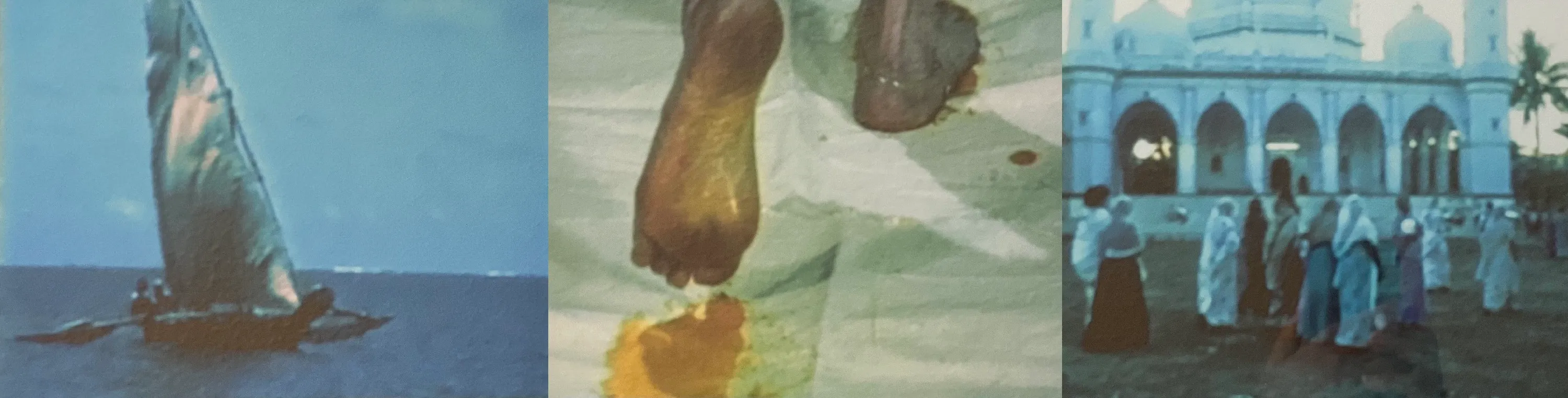
I think now that my earliest literacy was formed in that interval between silence and listening, not in the certainty of information but in the active work of receiving. That is where meaning first took root for me, not as statement but as relation.
That relation shaped my way into media art. I did not come to the visual by abandoning language, nor to the digital by abandoning the human sensorium. I came to these forms because they seemed able to hold discontinuity without pretending to resolve it. They could register layering, interruption, movement, and recurrence. They could admit that memory is not linear and that belonging is often assembled from fragments.
By the mid-1980s, when I first went to Western Front, the artist-run centre in Vancouver, to take workshops with Bob Richardson, also known as Spencer Cathey, on computational and integrated media, I felt that I had entered a place where these intuitions had begun to acquire form. Bob was one of those rare figures who made technical knowledge feel like an opening rather than a barrier. He moved easily between computer programming, image processing, and artistic curiosity. What he and others around Western Front understood was that technology was never just a tool. It was an interface, a way of rethinking relation, perception, and form.
That mattered enormously. Western Front was not simply interested in novelty. It had a deeper genealogy, shaped by Fluxus, intermedia, telecommunications, sound, radio, performance, and the artist-run conviction that form and sociality could not be separated. Robert Filliou’s idea of the Eternal Network was not a slogan there. It was a working ethos. The artwork was often less an object than a proposition, an exchange, a transmission, a set of conditions for encounter.

When I later became Director of Western Front in the 1990s, these questions had only intensified. It was a critical period in Canadian art and in the broader relation between culture and technology. I was studying video at Simon Fraser University because video, especially in the wake of the Portapak, had already altered the political and aesthetic field. It offered outsiders a way in. It allowed artists, especially women artists, to intervene in representation and public discourse without waiting for the permissions of older disciplines. It made recording cheaper, more mobile, and more immediate. It widened the means of address.
To say that now risks sounding self-evident. At the time it was anything but. It felt like a break in the order of things.
What drew me to that moment was not simply the arrival of new equipment, but the possibility that mediation itself could be reimagined. The 1992 Polymorphous Media workshop with Tetsuo Kogawa, where participants learned to build a one-watt FM transmitter and culminated in a live narrowcast, remains vivid to me for precisely that reason. Technology there was not scale, platform, or market capture. It was inhabitable. It could be made, shared, and repurposed. It could alter who speaks and how far a signal can travel. Likewise, when I worked with Thecla Schiphorst on the first Electronic Arts Festival in 1996, what interested me was not some fantasy of disembodied futurity, but the opposite: her insistence that body-based, somatic understanding had to enter the design process. The body was not outside technology. It was one of the terms through which technology had to be thought.
That is why digital literature, when I thought about it in 1998 or 1999, meant something quite different from what the phrase suggests now. It did not mean content on a screen. It did not mean the digitization of print. It meant that text itself had entered a changed condition. Language could now move like signal, branch like memory, arrive in fragments, and relay itself through response, interruption, and delay. Hypertext was compelling to me not because it was fashionable, but because it resembled diaspora. It linked without abolishing distance. It permitted simultaneity without false unity. It understood that a path through meaning need not be singular.
The digital at that time still carried an experimental charge. It had not yet fully hardened into platform logic. It had not yet submitted every utterance to metrics, extraction, and endless visibility. There was room for provisional communities, for artist-run intelligence, for forms that were not immediately instrumentalized. One could still feel that a network might become a site of exchange rather than merely a machine for sorting attention.
That world has changed. The digital is no longer a frontier. It is the atmosphere in which we live. Language now circulates under immense pressure: to be quick, legible, searchable, emotionally available, and endlessly responsive. The sentence is rarely left alone. It must announce itself, perform itself, and adapt itself to systems designed to convert expression into flow.
AI enters this field not as an intruder from nowhere, but as the clearest expression of tendencies long underway. It is often described as though it had suddenly transformed writing. In truth, it reveals what our culture has already done to language. It treats language as pattern. It ingests recurrence, predicts adjacency, models tone, and simulates coherence. It is dazzling at pattern recognition because language, in one sense, is patterned. Syntax is patterned. Genre is patterned. Rhetoric is patterned. Even voice has habits.
So does culture. A prayer is a pattern. A recipe is a pattern. A ritual is a pattern. A score is a pattern awaiting enactment. A family story repeated across generations is a pattern of continuity, though never a mere repetition. This is where the comparison becomes interesting. AI recognizes pattern statistically. Human beings recognize pattern existentially.
That difference matters because the machine sees recurrence without knowing stake. It can detect likelihood, but it cannot inherit burden. It can imitate grief, but it has not stood in a kitchen after bad news has travelled across oceans. It can model cadence, but it has not learned silence from a mother who knew that what is not given is lost. It can retrieve associations, but it does not know which of them were paid for by departure, translation, compromise, or survival.
This is why I do not find the question of AI simple. I am not interested in denunciation for its own sake. Pattern recognition is not alien to art. Artists work with pattern all the time, whether sonic, visual, narrative, or social. Communities survive by pattern too, by repeated forms that carry memory forward. In Fluxus, the score mattered because it was both minimal and open. It offered an instruction that did not close the work but made its realization possible. Much of migrant life operates in a similar way. A prayer is not just content. It is a score for relation. A recipe is not just method. It is a score for memory. A story retold in another country is not simply remembrance. It is an enactment of continuity.
What concerns me, then, is not pattern itself, but the evacuation of lived pressure from pattern. AI can produce language without ordeal. It can generate forms untethered from the experience that once made those forms necessary. Because it is so fluent, it tempts us to forget the difference.
Yet the difference remains essential. Literature is not only language arranged competently. It is language marked by necessity. It carries abrasion, risk, hesitation, density, and residue. It remembers that words are not simply units of transfer, but sites where reality presses back. The poetic remains important for this reason, not because it is decorative, but because it keeps language from becoming merely instrumental. It lets ambiguity remain alive. It grants silence an active role. It refuses the complete conversion of expression into utility.

In an increasingly mediated world, making meaning through words has become both easier and harder. It is easier because tools proliferate, archives expand, and forms circulate with unprecedented speed. It is harder because mediation now tends to smooth, prompt, predict, and pre-format what can be said. The challenge is no longer access alone. It is how to preserve depth, relation, and moral texture within systems that reward speed and approximation.
When I think across the arc from the pre-digital world to the early internet and now to the AI moment, I do not see a clean story of decline or progress. I see shifting conditions of attention. I see different regimes of pattern. I see different ways of carrying memory, and different risks of losing it.
What I still believe, perhaps more strongly now than before, is that language remains one of the last places where one human being can meet another without total capture. Not outside mediation, but through it and sometimes against its flattening tendencies. The task is not to rescue words from technology, as though such separation were possible. The task is to keep words answerable to life.
That means listening for what cannot be generated by fluency alone. It means recognizing that meaning does not arise only from pattern, but from the pressure that makes a pattern matter. It means remembering that between silence and listening there remains a human interval, and that much of what is worth carrying forward begins there.
References
1. Julia Polyck-O’Neill and Zainub Verjee, Zainub Verjee in Conversation with Julia Polyck O’Neilland in Adam Lauder (ed) Variable Conditions: Paracomputational Art in Canada, 1965-1995. MQUP, November 2023.
2. Verjee, Zainub, Through The Soles of My Mother’s Feet-Notes from a Sound Journal, Boo Magazine, No.6, Vancouver, 1995
3. Feature interview by Janet Smith: Zainub Verjee talks about the death of languages, neon, and the status of the artist, https://www.createastir.ca/articles/zainub-verjee-status-of-the-artist, August 15, 2021
4. Rajah, Niranjan. “Zainub Verjee: From Signifier to Signified.” In Other Places: Reflections on Media Arts in Canada, edited by Deanna Bowen. Toronto: Public Books, 2019.